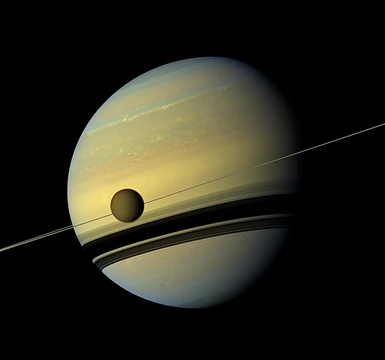
Giant planet
A massive planet composed mainly of volatiles, not solid matter.

A giant planet is a diverse type of planet much larger than Earth, sometimes referred to as a Jovian planet, with Jove being another name for the Roman god Jupiter. Giant planets are usually primarily composed of low-boiling point materials (volatiles), rather than rock or other solid matter, but mega-Earths do also exist. There are four such giant planets in the Solar System: Jupiter, Saturn, Uranus, and Neptune, and many extrasolar giant planets have been identified.
- type
- Planetary classification
- solar_system_examples
- Jupiter, Saturn, Uranus, Neptune
- primary_composition
- Volatiles (hydrogen, helium, water, methane, ammonia)
- alternative_names
- Jovian planet, gas giant, ice giant
- key_distinction
- Gas giants (Jupiter, Saturn) vs. ice giants (Uranus, Neptune)
Lore & Background
Giant planets are sometimes known as gas giants, but many astronomers now apply the term only to Jupiter and Saturn, classifying Uranus and Neptune, which have different compositions, as ice giants. Both names are potentially misleading; the Solar System's giant planets all consist primarily of fluids above their critical points, where distinct gas and liquid phases do not exist. Jupiter and Saturn are principally made of hydrogen and helium, whilst Uranus and Neptune consist of water, ammonia, and methane. Arguably it is something of a misnomer, because throughout most of the volume of these planets the pressure is so high that matter is not in gaseous form. Fluid planet would be a more accurate term. The observable atmospheres of all these planets are quite thin compared to their radii, only extending perhaps one percent of the way to the center. The defining differences between a very low-mass brown dwarf and a massive gas giant (~13 MJ) are debated. One school of thought is based on planetary formation; the other, on the physics of the interior of planets. Part of the debate concerns whether brown dwarfs must, by definition, have experienced nuclear fusion at some point in their history.
Reader's Guide
Giant planets are significant because they dominate the outer Solar System and are among the most detectable exoplanets. Their study has reshaped planetary science, revealing that planets can form with thick atmospheres of hydrogen and helium, often lacking solid surfaces. The distinction between gas giants and ice giants highlights compositional diversity, while the debate over the boundary with brown dwarfs underscores the continuum between planets and stars. Extrasolar giant planets that orbit very close to their stars, called hot Jupiters and hot Neptunes, were until the advent of space-borne telescopes the most common form of exoplanet known. The existence of mega-Earths challenges conventional theories for planetary formation, as massive planets should accrete large amounts of gas in addition to solid material. The term 'gas giant' remains a misnomer, as these planets are primarily fluid above their critical points. Understanding giant planets helps clarify the formation and evolution of planetary systems, including our own.
Did You Know?
- Jupiter and Saturn are principally made of hydrogen and helium, while Uranus and Neptune consist of water, ammonia, and methane.
- The 13-Jupiter-mass cutoff for brown dwarfs is a rule of thumb rather than something of precise physical significance.
- Mega-Earths are between 2.1 and 5.0 Earth radii and have densities higher than Earth's (5.5 g/cm³).
More in Astronomy 1-24
Spotted an error? Know more?
This is a living reference — every entry is fact-audited, and reader corrections feed straight into our audit queue. Suggest an edit · See this site's audit record