Cosmological constant
A coefficient in Einstein's equations explaining cosmic acceleration.

Lostbrethren · CC BY-SA 4.0
The cosmological constant (denoted by Λ) is a coefficient that Albert Einstein added to his field equations of general relativity in 1917 to achieve a static universe, later removed after Edwin Hubble confirmed cosmic expansion, and revived in the late 1990s to explain the accelerating expansion of the universe. It is closely associated with dark energy and is the simplest explanation for it, forming a key component of the standard ΛCDM model of cosmology.
- field
- Physical cosmology
- known_for
- Coefficient in Einstein's field equations; explanation for dark energy and cosmic acceleration
- introduced_by
- Albert Einstein
- year_introduced
- 1917
- associated_concept
- Dark energy, vacuum energy, cosmological constant problem
Lore & Background
The cosmological constant was originally introduced by Albert Einstein in his 1917 paper 'Cosmological considerations in the General Theory of Relativity.' He added it to his field equations because he was dissatisfied that otherwise his equations did not allow for a static universe—gravity would cause a non-expanding universe to contract. Einstein later called its introduction his 'biggest blunder' after Edwin Hubble's 1929 observations showed the universe is expanding, consistent with solutions by Alexander Friedmann that did not require the constant. From the 1930s until the late 1990s, most physicists thought the cosmological constant to be zero.
Reader's Guide
The cosmological constant's significance lies in its role as the simplest explanation for dark energy, which constitutes about 68% of the mass–energy density of the universe under the cosmological principle.
Did You Know?
- Einstein's static universe with the cosmological constant is unstable against matter density perturbations.
- Arthur Eddington claimed the cosmological constant version of the vacuum field equation expressed the property that the universe is 'self-gauging.'
Einstein's Reluctant Addition
In 1917, Albert Einstein published a paper on cosmological considerations within general relativity, in which he inserted a new parameter—now universally known as the cosmological constant—into his field equations. His motivation was practical: the equations as they stood in 1915 predicted a universe that could not remain still. Gravity would inevitably pull any initially non-expanding cosmos into collapse. Because the prevailing assumption of the era was that the universe was static, Einstein felt compelled to add a counterbalancing term. Yet he was deeply uncomfortable with the move. He later confessed that carrying this term left him with a bad conscience and that he could not accept such an ugly addition as a genuine feature of nature. The solution he constructed was also physically fragile. The equilibrium it produced was unstable: a slight perturbation in matter density would tip the universe into either runaway expansion or contraction. When Edwin Hubble's 1929 observations confirmed cosmic expansion—consistent with solutions Alexander Friedmann had already derived from Einstein's original equations—Einstein reportedly called his resistance to those predictions his biggest blunder, a phrase attributed to George Gamow.
The Supernova Surprise of 1998
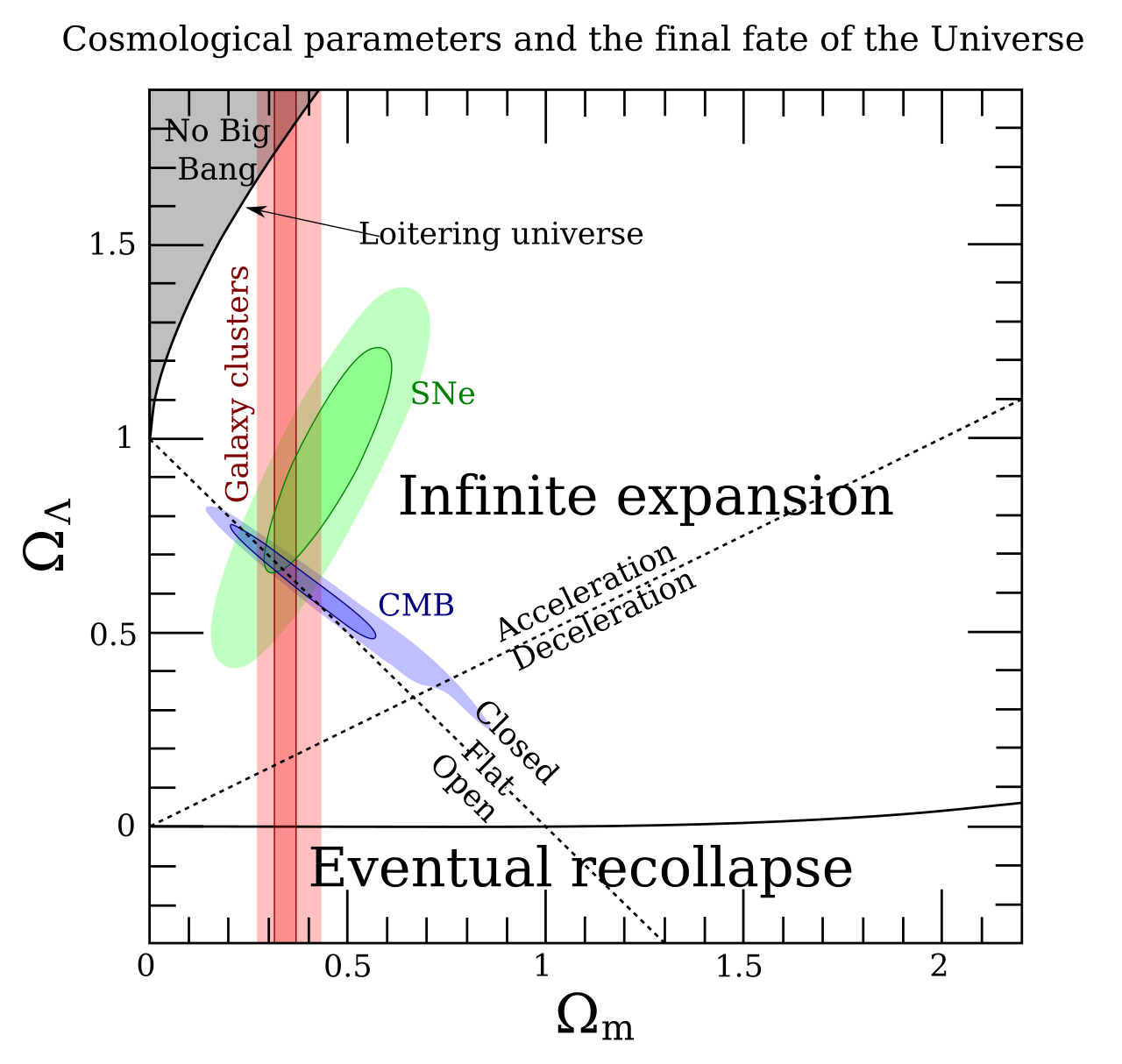
For nearly seven decades after Hubble's expansion discovery, the dominant view among physicists was that the cosmological constant equaled zero. That consensus shattered in 1998 when two independent teams—Saul Perlmutter at Lawrence Berkeley National Laboratory, and Brian Schmidt at the Australian National University working alongside Adam Riess at the Space Telescope Science Institute—announced a startling result from their surveys of type Ia supernovae. Their original expectation, grounded in Einstein's gravity, was that the mutual attraction of cosmic mass would be slowing the universe's expansion. Initial reports from the Supernova Cosmology Project in July 1997 even appeared to support that deceleration hypothesis. But the data quickly told a different story: the distant supernovae were receding faster than expected, revealing that the expansion of the universe is actually accelerating. Both groups published their findings in 1998, and the cosmological constant was promptly reinserted into the field equations of general relativity as the most straightforward mechanism capable of producing such acceleration.
The Worst Prediction in Physics
Quantum field theory, the framework underlying modern particle physics, describes empty space not as true emptiness but as a vacuum state populated by quantum fields. Each of these fields undergoes zero-point fluctuations at its ground state, generating a baseline energy density that permeates all of space. In principle, these fluctuations should feed directly into the value of the cosmological constant. In practice, the numbers are catastrophically wrong. When physicists compute the vacuum energy predicted by quantum field theory and compare it with the value inferred from cosmological observations, the theoretical figure overshoots the observed one by roughly 120 orders of magnitude. This staggering gap has been dubbed the worst theoretical prediction in the history of physics. The resulting puzzle, known as the cosmological constant problem, remains one of the deepest unsolved questions in all of science. Many researchers in the field hold that resolving it—understanding why the vacuum energy is so extraordinarily small compared to naive quantum expectations—may be the key to a complete understanding of nature.
The Backbone of Modern Cosmology
Today the cosmological constant occupies a central position in the standard model of cosmology, the framework known as ΛCDM. Observational studies conducted since the 1990s, assuming the cosmological principle that the universe is homogeneous and isotropic on large scales, indicate that roughly 68 percent of the total mass–energy content of the cosmos can be attributed to dark energy. The cosmological constant provides the simplest possible mathematical description of that dark energy: a constant energy density of space itself, unchanging over time and location. This makes Λ an elegant and economical addition to Einstein's field equations, requiring no new dynamical fields or exotic matter. It is closely tied to the broader concept of dark energy, which drives the accelerating expansion first detected in the late 1990s. Despite its simplicity, explaining why the constant carries the small positive value that observations demand—rather than zero or an astronomically larger figure—remains an open theoretical challenge. The cosmological constant thus stands simultaneously as a cornerstone of our best cosmological model and as a reminder of how much fundamental physics we still do not understand.
Gallery
Frequently Asked Questions
Who is Cosmological constant?
It is the symbol Λ, a mathematical term Einstein slipped into his general-relativity field equations in 1917 so the universe would remain static instead of collapsing under its own gravity. You can think of it as a built-in repulsive pressure that counteracts gravitational attraction on the largest scales.
What are Cosmological constant's powers or role?
In the standard ΛCDM model it behaves like a uniform energy density spread through all of space, steadily pushing galaxies apart and producing the observed acceleration of cosmic expansion. It is the simplest mathematical stand-in for whatever we collectively call dark energy.
How does Cosmological constant's story end?
Einstein introduced it in 1917 for a static cosmos, then abandoned it once Hubble's observations confirmed the universe was actually expanding. Late-1990s supernova data brought it roaring back as the leading explanation for accelerating expansion, and it still anchors modern cosmology today.
What is Cosmological constant's connection to Dark Energy?
The two are often treated as nearly interchangeable, because a constant Λ is the simplest possible form of dark energy. In practice, dark energy is the broader umbrella term, while the cosmological constant is one specific—and currently best-fitting—model nested inside it.
More in Astronomy 1-24
Spotted an error? Know more?
This is a living reference — every entry is fact-audited, and reader corrections feed straight into our audit queue. Suggest an edit · See this site's audit record