Dwarf galaxy
Small galaxies shaped by larger neighbors and dark matter.

ESA/Hubble & NASA · CC BY 4.0
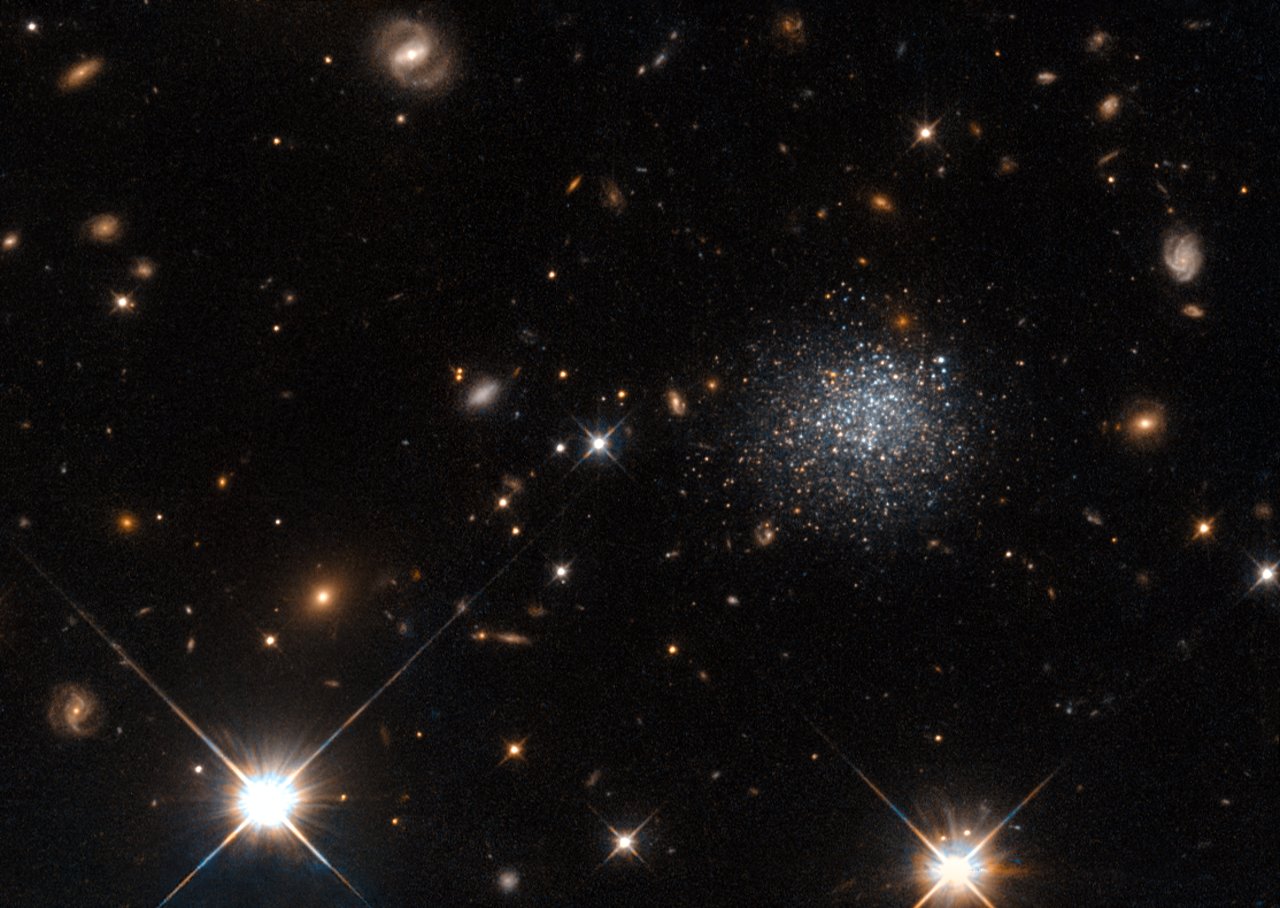
A dwarf galaxy is a small galaxy composed of about 1,000 up to several billion stars, compared to the Milky Way's 100–400 billion stars. Dwarf galaxies' formation and activity are thought to be heavily influenced by interactions with larger galaxies. Astronomers identify numerous types of dwarf galaxies, based on their shape and composition.
- size
- 1,000 to several billion stars
- comparison
- Milky Way: 100–400 billion stars
- common types
- dwarf elliptical, dwarf spheroidal, dwarf irregular, dwarf spiral, Magellanic type, blue compact dwarf, ultra-compact dwarf
- notable example
- Large Magellanic Cloud (over 30 billion stars, sometimes classified as dwarf)
- dark matter role
- Most galaxies, including dwarf galaxies, form in association with dark matter
Lore & Background
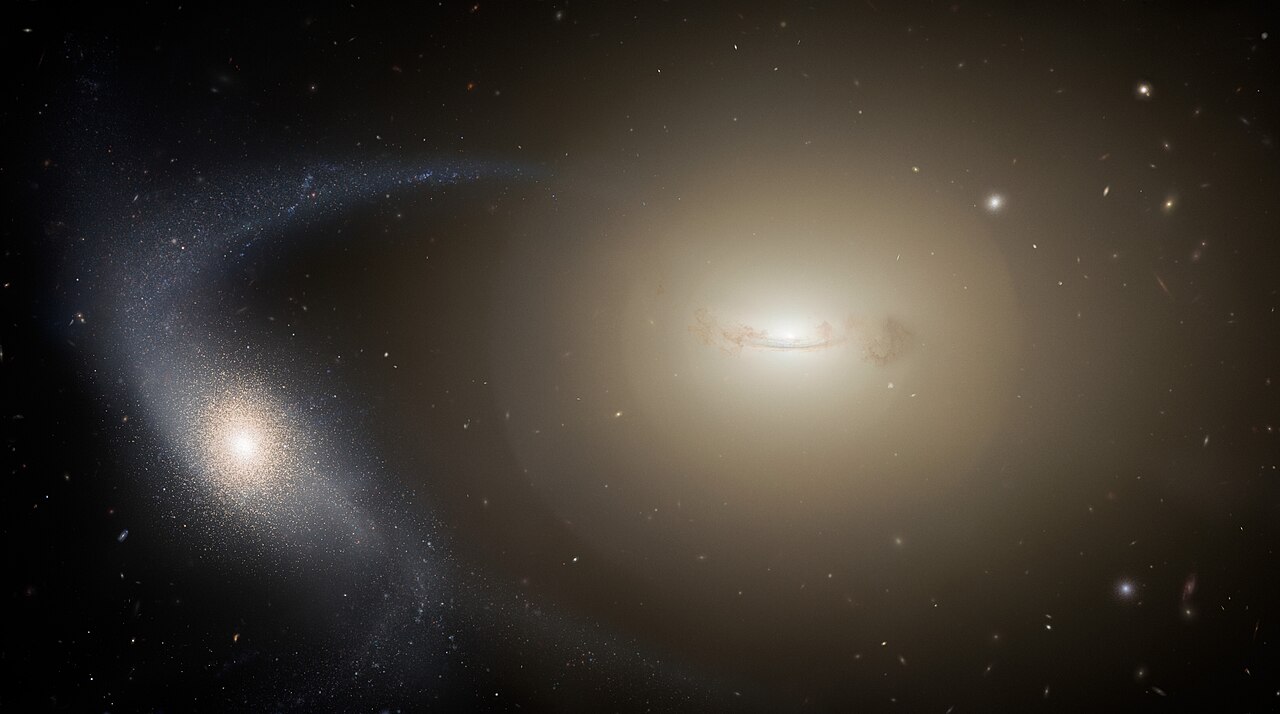
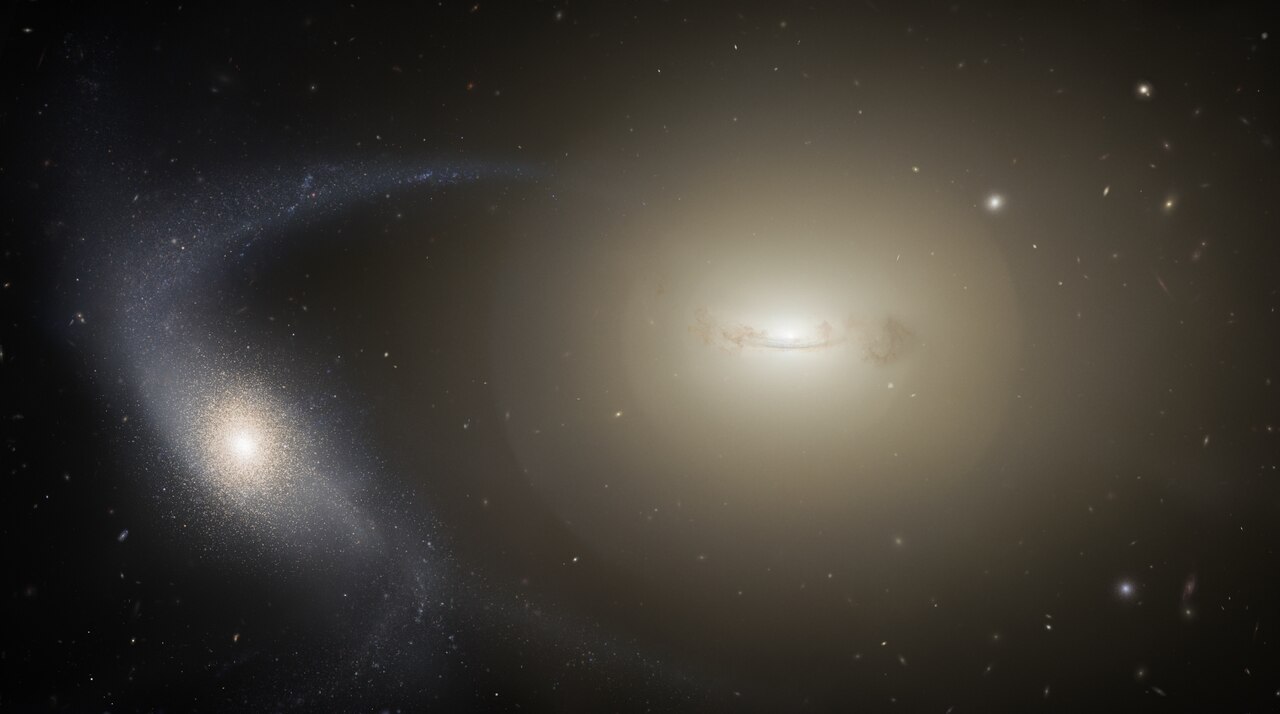
One theory states that most galaxies, including dwarf galaxies, form in association with dark matter, or from gas that contains metals. However, NASA's Galaxy Evolution Explorer space probe identified new dwarf galaxies forming out of gases with low metallicity. These galaxies were located in the Leo Ring, a cloud of hydrogen and helium around two massive galaxies in the constellation Leo. Because of their small size, dwarf galaxies have been observed being pulled toward and ripped by neighboring spiral galaxies, resulting in stellar streams and eventually galaxy merger. Recent studies have shown that around 30–50% of dwarf galaxies that reside in low-density environments are quenched, meaning they have little star formation. This indicates that dwarf galaxy evolution is largely influenced by stellar or active galactic nuclei as well as the environments of nearby massive galaxies.
Reader's Guide
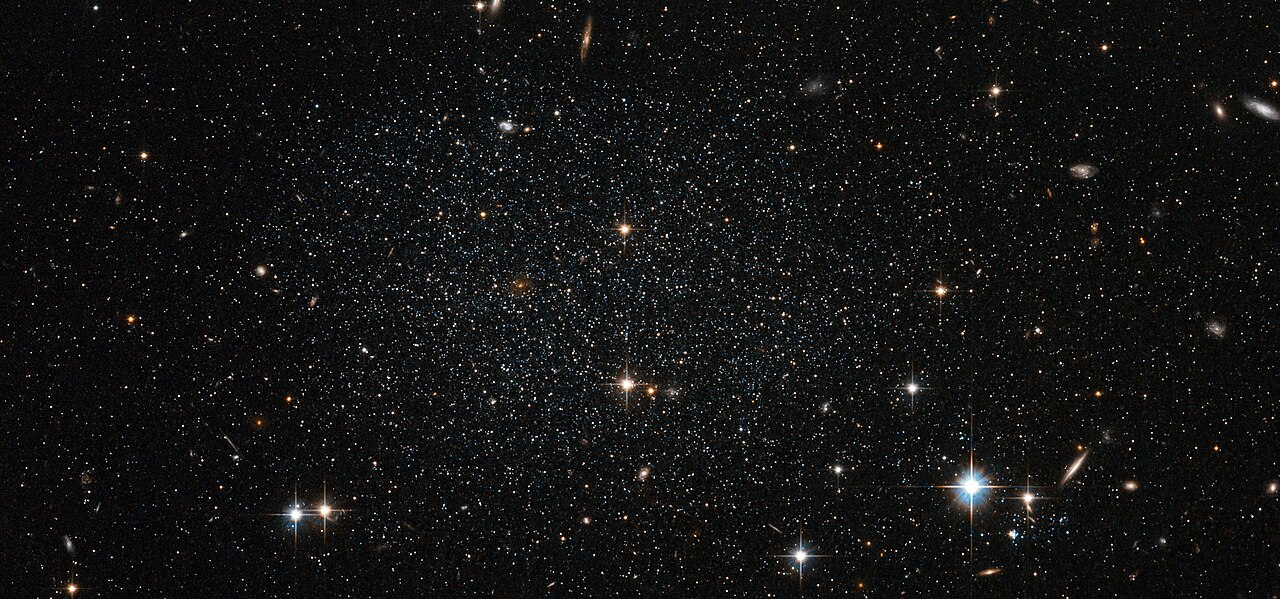
Dwarf galaxies are significant because they serve as laboratories for understanding galaxy formation, dark matter, and the early universe. Their small size makes them sensitive to environmental effects such as tidal stripping and ram pressure, providing insights into how larger galaxies evolve. Blue compact dwarf galaxies contain large clusters of young, hot, massive stars and consume gas intensely, while ultra-compact dwarf galaxies (UCDs) are very dense and may be stripped cores of larger galaxies. Studies of local dwarf galaxies, such as the Sculptor Dwarf Galaxy, allow tests of the standard cosmological model. The classification of the Large Magellanic Cloud remains disputed, with some considering it a dwarf galaxy and others a full-fledged galaxy.
Did You Know?
- The Large Magellanic Cloud, which closely orbits the Milky Way and contains over 30 billion stars, is sometimes classified as a dwarf galaxy; others consider it a full-fledged galaxy.
- More than 20 known dwarf galaxies orbit the Milky Way, and recent observations suggest the largest globular cluster in the Milky Way, Omega Centauri, is the core of a dwarf galaxy with a black hole at its center.
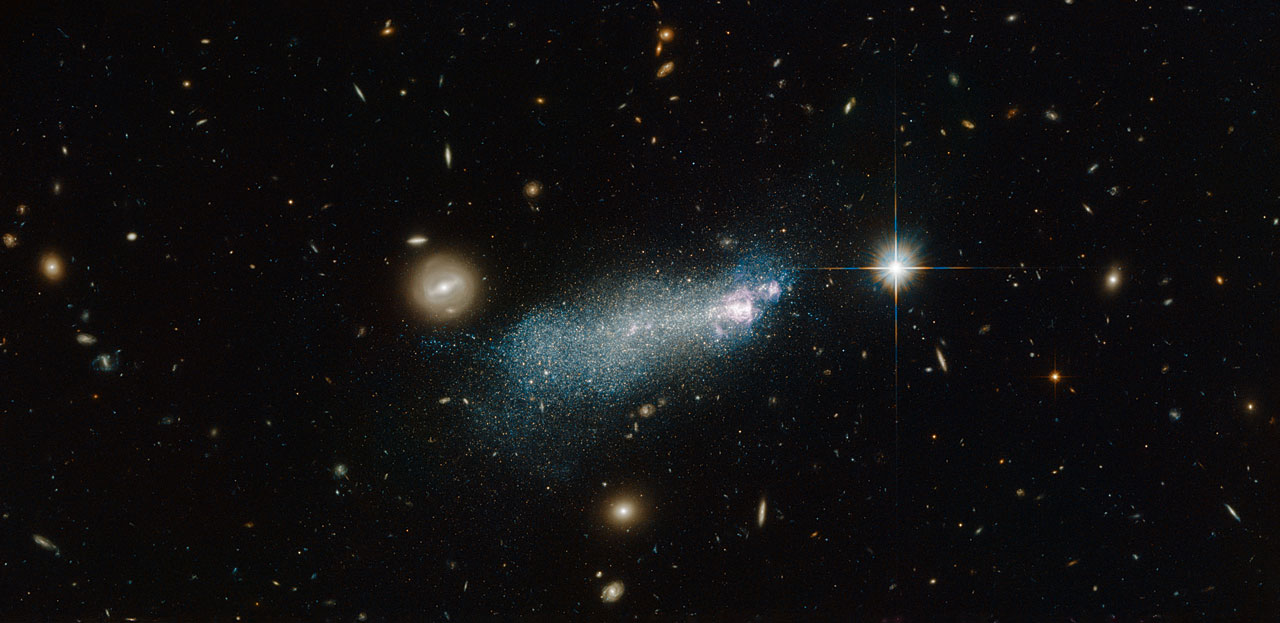
- Blue compact dwarf galaxies contain large clusters of young, hot, massive stars, causing the galaxy itself to appear blue in colour.
Formation & the Shaping Hand of Environment
Dwarf galaxies occupy the small end of the galactic spectrum, hosting anywhere from roughly a thousand to several billion stars, a sliver of the Milky Way's 100 to 400 billion. Their origins remain an active puzzle. One leading idea holds that most galaxies, dwarfs included, assemble in connection with dark matter or from gas already enriched with metals. Yet NASA's Galaxy Evolution Explorer probe revealed a distinct pathway: fresh dwarfs coalescing from gas with very low metal content, spotted inside the Leo Ring, a sprawling hydrogen-and-helium cloud encircling two massive galaxies in the constellation Leo. Their modest size makes dwarfs especially vulnerable to gravitational interference. They can be dragged toward, stretched, and ultimately shredded by neighboring spiral galaxies, producing luminous stellar streams before a full merger occurs. Recent findings from the Hyper Suprime-Cam Subaru Strategic Program indicate that roughly thirty to fifty percent of dwarfs in sparse cosmic neighborhoods are quenched, showing almost no ongoing star formation. This points to a picture where a dwarf's fate is shaped as much by its surroundings—stellar feedback, active galactic nuclei, and the gravitational reach of massive neighbors—as by its own internal physics.
A Taxonomy of Small Worlds
Astronomers sort dwarf galaxies into several distinct categories based on morphology and stellar composition. The family includes dwarf ellipticals, dwarf spheroidals—once treated as a subcategory of dwarf ellipticals but now recognized as a separate class—dwarf irregulars, dwarf spirals, Magellanic-type dwarfs, blue compact dwarfs, and ultra-compact dwarfs. Blue compact dwarfs stand out for their vivid blue hue, produced by dense clusters of young, hot, massive stars. Because they are built from star clusters rather than a smooth disk or spheroid, they lack a uniform shape. They devour gas at an intense rate, making star formation particularly violent. As successive generations of stars form at staggered intervals, the galaxy cools between episodes, gradually reshaping its structure over time. Nearby examples include NGC 1705, NGC 2915, NGC 3353, UGC 6541, and UGCA 281. At the opposite extreme, ultra-faint dwarfs contain only a few hundred to a hundred thousand stars, making them the faintest galaxies known. They visually resemble globular clusters but differ critically: they harbor substantial dark matter and are far more spatially extended.
The Local Neighborhood & Tidal Origins
The Local Group hosts a rich population of dwarf galaxies, many orbiting the Milky Way, Andromeda, or the Triangulum Galaxy. More than twenty known dwarfs circle the Milky Way alone, and a 2007 paper proposed that a large fraction were born from galactic tides during the early gravitational dance between the Milky Way and Andromeda. In such tidal events, streams of gas and stars are pulled away from the parent galaxies and their dark-matter halos, seeding new, smaller systems. A 2018 study pushed the timeline further back, suggesting some local dwarfs formed during the cosmic Dark Ages, within the first billion years after the Big Bang. Meanwhile, nearby star-forming dwarfs display blue colors, high star-formation rates, and low metallicities, hinting they may have assembled most of their stellar mass within the last billion years. One of the most striking revelations came from the discovery that Omega Centauri, the Milky Way's largest globular cluster, is likely the stripped core of a dwarf galaxy that once harbored a central black hole before being absorbed. Precise stellar-motion measurements in systems like the Sculptor Dwarf Galaxy have also provided a natural laboratory for testing predictions of the standard cosmological model.
Ultra-faint & Ultra-compact Dwarfs
Two extreme classes push the boundaries of what a galaxy can be. Ultra-faint dwarfs, first identified in 2005 through the Sloan Digital Sky Survey, contain as few as a few hundred stars and as many as a hundred thousand, making them the faintest galaxies in the observable universe. They look deceptively similar to globular clusters, yet they carry a significant dark-matter component and are far more spatially extended. UFDs are the most dark-matter-dominated systems known. Every one discovered so far is ancient, likely assembled only a few million years after the Big Bang, well before the epoch of reionization. Theoretical work has even hypothesized a population of younger UFDs forming at much later epochs, though none have been observed yet. Ultra-compact dwarfs, discovered in the 2000s, represent the opposite extreme in size: roughly two hundred light years across yet packed with about a hundred million stars, giving them extraordinarily high stellar densities. Two main formation scenarios are debated: the tidal-threshing model, in which they are surviving cores of nucleated dwarf ellipticals stripped while passing through dense clusters, and the simpler proposal that they are massive star clusters. UCDs have been catalogued in the Virgo, Fornax, Abell 1689, and Coma Clusters, with a sample of roughly one hundred found in the core region of one such cluster.
Gallery
Frequently Asked Questions
What is a dwarf galaxy?
A dwarf galaxy is a compact stellar system containing anywhere from roughly a thousand stars up to a few billion, making it far smaller than major spiral galaxies. It represents one of the most common types of galaxies in the universe.
How does a dwarf galaxy compare in size to the Milky Way?
While the Milky Way holds an estimated 100 to 400 billion stars, a typical dwarf galaxy might contain only a few thousand to a few billion. This means even the largest dwarfs are a tiny fraction of our home galaxy's stellar population.
What are the main categories of dwarf galaxies?
Astronomers classify them into several shapes, including dwarf elliptical, dwarf spheroidal, dwarf irregular, dwarf spiral, Magellanic type, blue compact dwarf, and ultra-compact dwarf. The classification depends on the galaxy's overall morphology and the mix of stars and gas it contains.
What forces shape a dwarf galaxy's evolution?
Interactions with nearby larger galaxies tend to dominate how dwarfs form and behave over time. Additionally, dark matter plays a central role in their assembly, as most galaxies—dwarfs included—grow within dark matter halos.
Can you give a well-known example of a dwarf galaxy?
The Large Magellanic Cloud, visible from Earth's southern hemisphere, is a classic case with more than 30 billion stars. It is large enough that some astronomers debate whether it truly qualifies as a dwarf or sits on the boundary between dwarf and regular galaxies.
More in Astronomy 1-24
Spotted an error? Know more?
This is a living reference — every entry is fact-audited, and reader corrections feed straight into our audit queue. Suggest an edit · See this site's audit record