Cosmic inflation
Theory of exponential early universe expansion explaining cosmic structure.

FrankvEck · CC BY-SA 4.0
Cosmic inflation, also called cosmological inflation or simply inflation, is a theory in physical cosmology describing an exponential expansion of space in the very early universe. This expansion supercooled the universe and ended when the energy content of the driving field condensed into hot, dense particles, a process known as reheating. The theory was developed in the late 1970s and early 1980s by several theoretical physicists, including Alexei Starobinsky, Alan Guth, Andrei Linde, and Paul Steinhardt, and explains the origin of the large-scale structure of the cosmos.
Lore & Background
Inflation theory was developed in the late 1970s and early 1980s, with notable contributions by Alexei Starobinsky at Landau Institute for Theoretical Physics, Alan Guth at Cornell University, and Andrei Linde at Lebedev Physical Institute. The theory was further developed in the early 1980s.
Reader's Guide
Cosmic inflation resolves several problems in Big Bang cosmology discovered in the 1970s, including the flatness problem, the horizon problem, and the magnetic-monopole problem. The theory explains why the universe appears isotropic, why the cosmic microwave background radiation is evenly distributed, why the universe is flat, and why no magnetic monopoles have been observed. Quantum fluctuations in the microscopic inflationary region, magnified to cosmic size, become the seeds for galaxy formation and structure in the universe. However, some scientists dissent from this position, and the detailed particle physics mechanism responsible for inflation remains unknown. The hypothetical field thought to be responsible is called the inflaton.
Did You Know?
- During inflation, distances between points doubled every 10⁻³⁷ seconds, and the expansion lasted at least 10⁻³² seconds.
- All mass-energy in currently visible galaxies was packed within a sphere of radius about 4 × 10⁻²⁹ meters before inflation, growing to about 0.9 meters by its end.
- Inflation resolves the magnetic-monopole problem by separating monopoles as the universe expands, lowering their observed density by many orders of magnitude.
- The flatness problem arises because the early universe must have had a density departing from the critical value by one part in 10⁶⁰ or less.
The Explosive Birth of Space
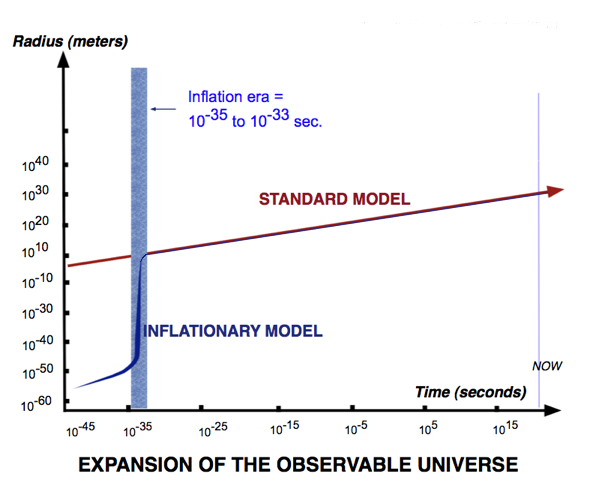
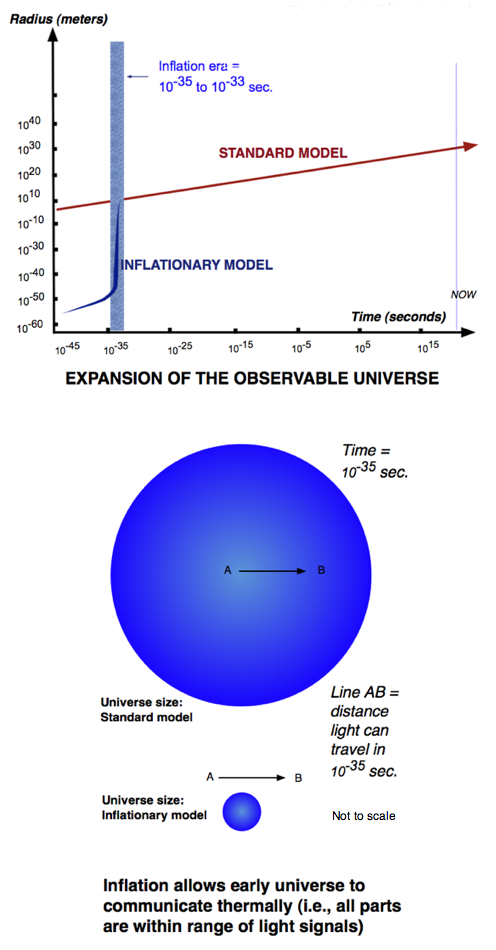
Cosmic inflation proposes that the universe underwent a period of exponential expansion in its earliest moments. During this brief episode, distances between points doubled roughly every 10 to the minus 37th power of a second, and the entire process lasted at least 10 to the minus 35th power of a second, though its precise duration remains uncertain. The scale of this growth is staggering: all the mass-energy now visible in our galaxies was compressed into a sphere roughly 4 times 10 to the minus 29th power of a meter in radius, which ballooned to approximately 0.9 meters by the time inflation ceased. The expansion supercooled the universe, and when it ended, the energy stored in the driving field—hypothetically called the inflaton—condensed into hot, dense particles in a process known as reheating. This produced a quark-soup phase that retained tiny density variations inherited from quantum fluctuations in the original smooth patch. After inflation, the universe kept expanding, but at a far more modest pace.
Solving the Big Bang's Blind Spots
The standard Big Bang model, while successful in explaining the cosmic microwave background and primordial element synthesis, relied on initial conditions that were difficult to justify. It lacked a mechanism to generate the density contrasts needed for gravity to pull mass into stars and galaxies. Particle physicists examining the very early universe uncovered further puzzles. In 1979, Alan Guth, investigating why no magnetic monopoles—predicted by Grand Unified Theories—have ever been detected, discovered that a positive-energy false vacuum would trigger exponential expansion under general relativity. This single insight also addressed the flatness problem, where the universe's geometry appeared unnaturally fine-tuned, and the horizon problem, which questioned how distant regions could share the same temperature. Inflation dilutes monopoles by stretching space around them, reducing their density by many orders of magnitude. While some skeptics, like Martin Rees, questioned whether solving a problem about hypothetical particles was truly compelling, the resolution of the flatness and horizon issues gave the theory broader credibility.
The Architects and Their Recognition
Inflationary cosmology emerged in the late 1970s and early 1980s through the independent and complementary work of several theoretical physicists. Alexei Starobinsky at the Landau Institute for Theoretical Physics, Alan Guth at Cornell University, and Andrei Linde at the Lebedev Physical Institute each made foundational contributions. Paul Steinhardt of Princeton also played a significant role in developing the concept. Their collective work earned substantial recognition over the years. In 2002, Guth then at M.I.T., Linde at Stanford, and Steinhardt shared the Dirac Prize for developing the concept of inflation in cosmology. In 2012, Guth and Linde received the Breakthrough Prize in Fundamental Physics for inventing and developing inflationary cosmology. Then in 2014, Starobinsky, Guth, and Linde were awarded the Kavli Prize specifically for pioneering the theory of cosmic inflation. These honors spanned multiple institutions and decades, reflecting the theory's gradual consolidation from a bold hypothesis into a cornerstone of modern cosmology.
Evidence, Seeds of Structure, and Open Questions
Inflation offers a compelling explanation for the large-scale structure of the cosmos. Quantum fluctuations in the tiny, smooth region that underwent inflation were magnified to cosmic scales, becoming the seeds from which galaxies and larger structures eventually grew. The theory also accounts for why the universe appears isotropic—looking the same in every direction—and why the cosmic microwave background radiation is distributed so evenly. Observational support has accumulated over time: the COBE satellite detected temperature anisotropies in 1992 that exhibited nearly scale-invariant spectra, matching inflationary predictions, and subsequent WMAP results provided further strong evidence. Nevertheless, the detailed particle physics mechanism behind inflation remains unknown, and the hypothetical inflaton field has never been directly detected. Some scientists continue to dissent from the inflationary interpretation, and the full duration of the inflationary epoch is still uncertain. The theory thus stands as a powerful but incomplete framework, with its deepest mechanisms still awaiting discovery.
Gallery

Frequently Asked Questions
What is cosmic inflation?
Cosmic inflation is a cosmological model proposing that space underwent a rapid, exponential stretching during the earliest fraction of a second after the Big Bang. This brief burst of growth expanded the universe to an enormous scale and set the stage for everything that followed.
Who developed the inflation theory?
The framework was built in the late 1970s and early 1980s by a group of theoretical physicists, most notably Alexei Starobinsky, Alan Guth, Andrei Linde, and Paul Steinhardt. Each contributed key pieces that together formed the modern inflationary picture.
What problem does cosmic inflation solve?
It accounts for why the observable universe looks so uniform in temperature and geometry across vast distances, and it provides a mechanism for seeding the tiny density fluctuations that later grew into galaxies and clusters. In short, it bridges the gap between an early quantum state and the large-scale structure we observe today.
How did the inflationary period end?
Inflation stopped when the energy stored in the driving field decayed into a hot soup of particles and radiation, a transition called reheating. This reheating event effectively kicked off the hot Big Bang phase described by standard cosmology.
More in Astronomy 1-24
Spotted an error? Know more?
This is a living reference — every entry is fact-audited, and reader corrections feed straight into our audit queue. Suggest an edit · See this site's audit record