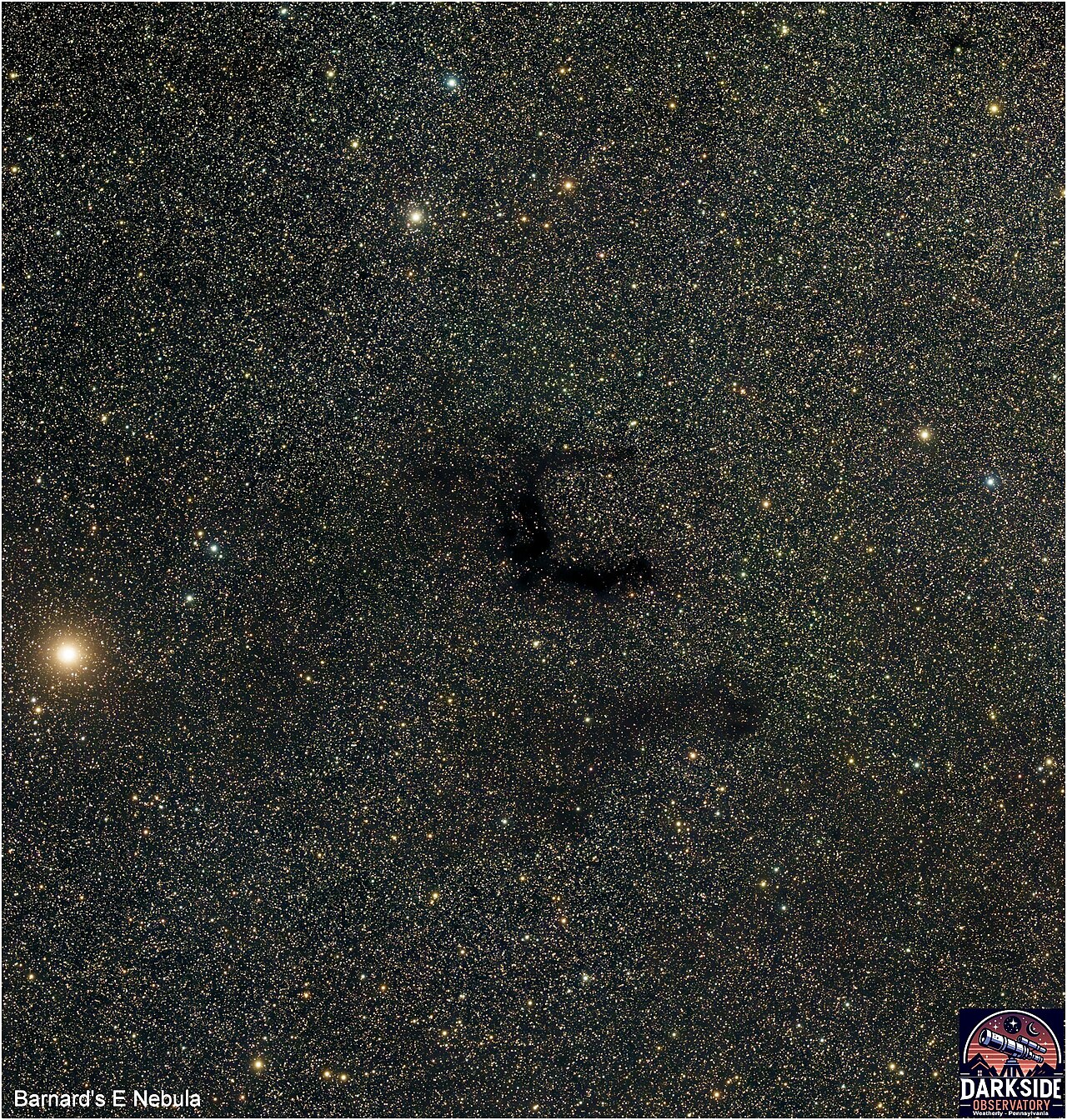
Dark nebula
Dense interstellar clouds that block visible light from background objects.

Thedarksideobservatory · CC BY-SA 4.0
A dark nebula, also known as an absorption nebula, is a type of interstellar cloud, particularly a molecular cloud, so dense that it obscures visible light from objects behind it, such as background stars and emission or reflection nebulae. The extinction is caused by interstellar dust grains in the coldest, densest parts of molecular clouds, and isolated small dark nebulae are called Bok globules.
- visibility
- Visible to the naked eye as dark patches against the Milky Way; also observable in radio and infrared
Lore & Background
Dark nebulae appear dark because of sub-micrometre-sized dust particles coated with frozen carbon monoxide and nitrogen, which effectively block visible wavelengths. Also present are molecular hydrogen, atomic helium, and molecules such as C18O, CS, NH3, H2CO, c-C3H2, and the molecular ion N2H+, all relatively transparent. Their form is very irregular, with no clearly defined outer boundaries, sometimes taking on convoluted serpentine shapes.
Reader's Guide
Dark nebulae are significant because they obscure visible light from background stars and nebulae, revealing the presence of dense interstellar material. They are associated with Giant Molecular Clouds and are sites of star formation and maser emission in their central regions. The closest and largest dark nebulae are visible to the naked eye as dark patches against the Milky Way, such as the Coalsack Nebula and the Great Rift, and are sometimes known as dark cloud constellations. Their study relies on radio and infrared astronomy, as the objects behind them are only observable at those wavelengths. Dark nebulae, along with molecular clouds, form molecular cloud complexes, contributing to our understanding of the structure and evolution of the interstellar medium.
Did You Know?
- Dark nebulae are also called absorption nebulae.
- Isolated small dark nebulae are called Bok globules.
- The closest and largest dark nebulae are visible to the naked eye as dark patches against the Milky Way.
- In the central regions of dark nebulae, events such as star formation and maser emission take place.
The Mechanism of Obscuration
Dark nebulae, also called absorption nebulae, are interstellar clouds—particularly molecular clouds—whose extreme density prevents visible light from passing through. The culprit is interstellar dust grains found in the coldest, densest regions of these clouds. These sub-micrometre-sized particles are coated with frozen carbon monoxide and nitrogen, and they effectively block visible wavelengths from reaching the observer. Behind these veils, background stars, emission nebulae, and reflection nebulae are rendered invisible to the naked eye. However, the obscured objects are not truly gone; they remain detectable through radio and infrared astronomy techniques, which can penetrate the dust that visible light cannot. The remaining material in the cloud—molecular hydrogen, atomic helium, and various molecules like ammonia, formaldehyde, and diazenylium—is relatively transparent, meaning the darkness is specifically a product of the dust component rather than the gas itself.
Shape, Scale, and Classification
Dark nebulae defy neat geometry. Their forms are highly irregular, lacking clearly defined outer boundaries, and they sometimes assume convoluted, serpentine shapes that make them look almost organic against the starfield. In terms of scale, they exist on a broad spectrum: isolated small examples are known as Bok globules, while clusters and large complexes of dark nebulae are associated with Giant Molecular Clouds. Together with molecular clouds, dark nebulae form what are called molecular cloud complexes. This wide range in size and grouping means that dark nebulae are not a single uniform phenomenon but rather a diverse family of structures, spanning from compact, solitary blobs to vast, interconnected complexes that dominate entire regions of the interstellar medium.
Seeing the Invisible
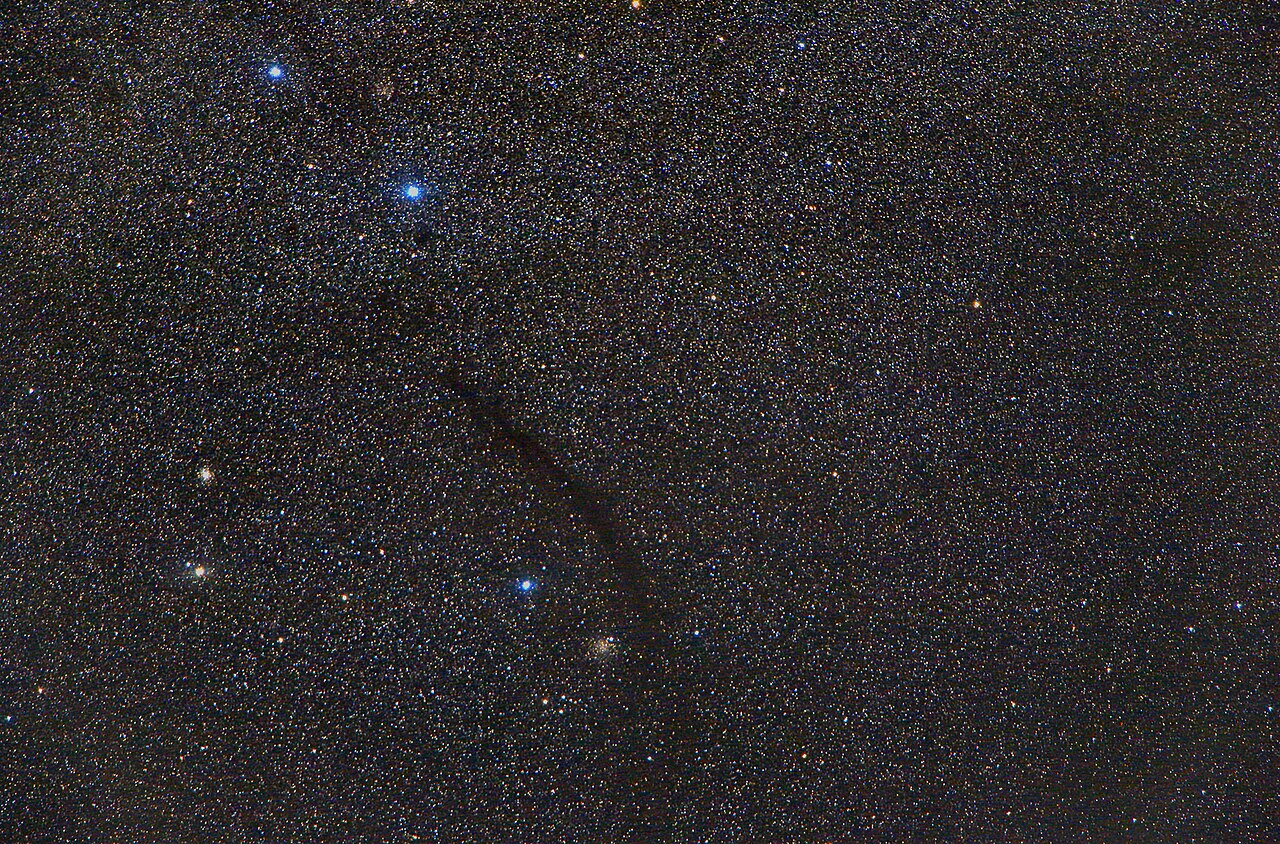
Paradoxically, some of the most impressive dark nebulae are visible without any instrument at all. The closest and largest examples stand out because they suffer the least obscuration from intervening stars between Earth and the nebula, and because their large angular size makes them prominent. They appear as dark patches silhouetted against the brighter background of the Milky Way. Two famous naked-eye examples are the Coalsack Nebula and the Great Rift. These prominent dark features are sometimes referred to as dark cloud constellations and have been given a variety of names by observers over the centuries. For anything smaller or more distant, however, the dust veil is impenetrable to visible light, and astronomers must turn to radio and infrared wavelengths to peer through the obscuring material and study the stars and nebulae hidden behind.
Cradles of New Stars
Beneath the dark, light-blocking exterior of these nebulae, significant cosmic events are underway. In the central regions of dark nebulae and the broader molecular clouds they inhabit, the formation of new stars takes place. Alongside this stellar birth, maser emission occurs within these same central regions, producing a natural radio signal that astronomers can detect even when visible light cannot penetrate the dust. The coldest, densest parts of the molecular clouds—where the dust grains responsible for obscuration reside—are also where these transformative events unfold. In this way, the very regions that render the nebula invisible to the naked eye are simultaneously the most dynamically active, hosting both the birth of stars and the emission of powerful maser radiation.
Gallery
Frequently Asked Questions
What is a dark nebula?
A dark nebula is a dense interstellar cloud, typically a molecular cloud, thick enough to block visible light from stars and other objects behind it. It is also called an absorption nebula because it absorbs rather than emits light.
Why does a dark nebula look dark?
Tiny interstellar dust grains concentrated in the coldest, densest parts of the cloud scatter and absorb visible light. This extinction effect creates a silhouette against any brighter background, such as the Milky Way or a nearby emission nebula.
Can you see a dark nebula with the naked eye?
Yes, larger dark nebulae appear as dark patches silhouetted against the glow of the Milky Way without any instrument. They are also detectable through radio and infrared observations, which can penetrate the dust that blocks visible light.
What is a Bok globule?
A Bok globule is the term used for a small, isolated dark nebula. These are compact, self-contained clumps of dense interstellar material that stand apart from larger cloud structures.
How is a dark nebula different from other types of nebulae?
While emission and reflection nebulae are defined by the light they produce or scatter, a dark nebula is defined by the light it blocks. It acts as an opaque screen, hiding the stars and glowing gas behind it rather than shining on its own.
More in Astronomy 1-24
Spotted an error? Know more?
This is a living reference — every entry is fact-audited, and reader corrections feed straight into our audit queue. Suggest an edit · See this site's audit record